Steam and the gallopers
In the 1860s steam engines arrived on the fairground, and the roundabout became a machine.
Bolton, New Year’s Day 1861
The first evidence of a steam-powered fairground ride is Thomas Bradshaw’s merry-go-round at the old Pot Market in Bolton on New Year’s Day 1861. Grace’s Guide Its boiler was made at Pollit’s Boiler Yard, its engine by Rogerson and Brimelow, and Bradshaw carved the horses himself. He patented the idea in 1863. Grace’s Guide
In 1863 the Halifax Courier described a “roundabout of huge proportions, driven by a steam engine which whirled around with such impetuosity, that the wonder is the daring riders are not shot off like cannon-ball, and driven half into the middle of next month.” Grace’s Guide
Frederick Savage of King’s Lynn
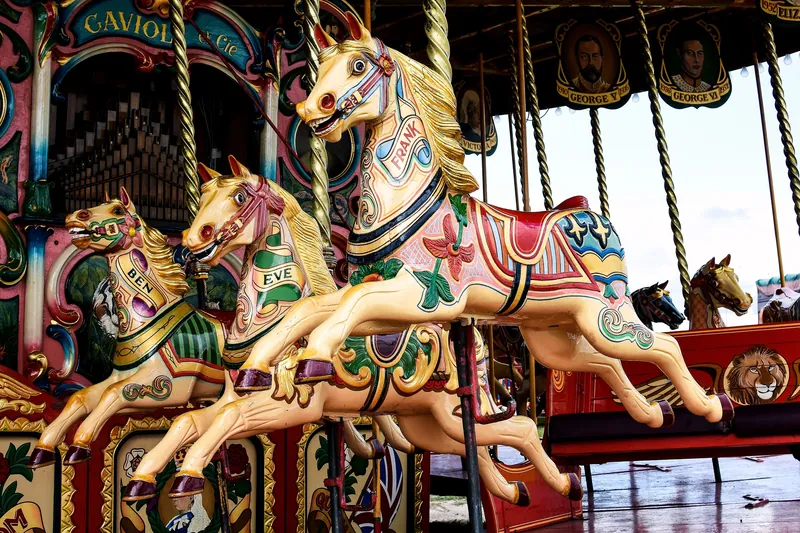
Frederick Savage was born in 1828, the son of a weaver. Self-taught, he built steam threshing machines, ploughs and traction engines for Fenland farmers. Lynn Museum
His company began repairing showmen’s rides for King’s Lynn’s travelling fair, the Mart. Before long it was building gallopers and carousels, and it came to dominate fairground manufacturing. Lynn Museum
His works in Lynn was the St Nicholas Ironworks. Lynn News The Herschell Carrousel Factory Museum notes that engineers like Savage took designs from farm machinery to build rides that were reliable and durable. Herschell Carrousel Factory Museum Lynn Museum keeps Savage’s drawings, including a chalk design for a galloper cockerel from around 1920, and has a life-size galloper on show. Lynn News
Why gallopers go clockwise
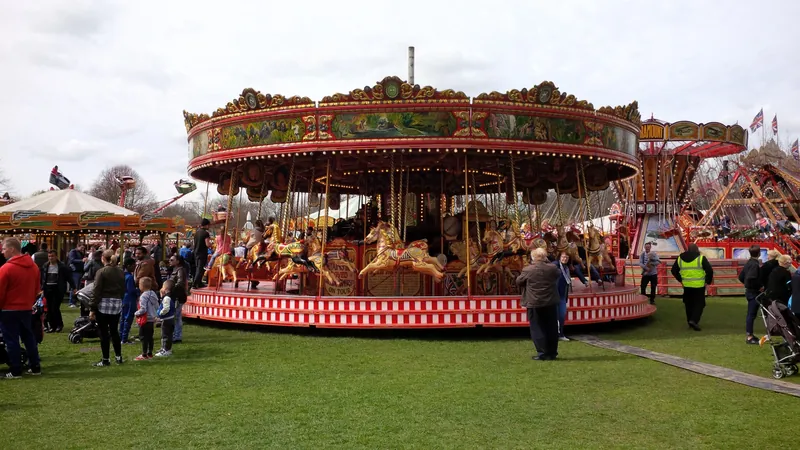
According to the Dentzel Carousel Company’s glossary, most American and continental European carousels turn anticlockwise, while in England and several other Commonwealth countries they turn clockwise. Dentzel Carousel Co. It links the British direction to the old custom of passing other riders on the left and mounting a horse from the left. Dentzel Carousel Co.